Tuesday, 7 February 2017

Arithmetic Progression

ARITHMETIC PROGRESSION

Arithmetic Sequences

An Arithmetic Sequence is made by adding the same value each time.
Example:
1, 4, 7, 10, 13, 16, 19, 22, 25, ...
This sequence has a difference of 3 between each number.
The pattern is continued by adding 3 to the last number each time, like this:

Example:
3, 8, 13, 18, 23, 28, 33, 38, ...
This sequence has a difference of 5 between each number.
The pattern is continued by adding 5 to the last number each time, like this:

The value added each time is called the "common difference"
What is the common difference in this example?
19, 27, 35, 43, ...

Answer: The common difference is 8
The common difference could also be negative:
Example:
25, 23, 21, 19, 17, 15, ...
This common difference is −2
The pattern is continued by subtracting 2 each time, like this:

Special Sequences
Triangular Numbers
1, 3, 6, 10, 15, 21, 28, 36, 45, ...
This Triangular Number Sequence is generated from a pattern of dots which form a triangle.
By adding another row of dots and counting all the dots we can find the next number of the sequence:

Square Numbers
0, 1, 4, 9, 16, 25, 36, 49, 64, 81, ...
They are the squares of whole numbers:
0 (=0×0)
1 (=1×1)
4 (=2×2)
9 (=3×3)
16 (=4×4)
etc...
Cube Numbers
1, 8, 27, 64, 125, 216, 343, 512, 729, ...
They are the cubes of the counting numbers (they start at 1):
1 (=1×1×1)
8 (=2×2×2)
27 (=3×3×3)
64 (=4×4×4)
etc...
Fibonacci Numbers
0, 1, 1, 2, 3, 5, 8, 13, 21, 34, ...

The Fibonacci Sequence is found by adding the two numbers before it together.
The 2 is found by adding the two numbers before it (1+1)
The 21 is found by adding the two numbers before it (8+13)
The next number in the sequence above would be 55 (21+34)

Can you figure out the next few numbers?

QUESTION

Q.1

What is the sum of the eleventh to twentieth terms (inclusive)of the arithmetic sequence
7, 12, 17, 22, ... ?

A
154
B
295
C
795
D
1,090


Q.2

What is the fiftieth term of the arithmetic sequence 3, 7, 11, 15, ... ?

A
53
B
151
C
199
D
203


Q.3

What is the thirty-second term of the arithmetic sequence -12, -7, -2, 3, ... ?

A
143
B
148
C
153
D
167

Inequalities

INEQUALITIES

Solving Inequalities

Sometimes we need to solve Inequalities like these:
Symbol
Words
Example
>
greater than
x + 3 > 2
<
less than
7x < 28
greater than or equal to
5 ≥ x - 1
less than or equal to
2y + 1 ≤ 7

Solving

Our aim is to have x (or whatever the variable is) on its own on the left of the inequality sign:
Something like:x < 5
or:y ≥ 11
We call that "solved".

How to Solve

Solving inequalities is very like solving equations ... we do most of the same things ...
... but we must also pay attention to the direction of the inequality.
greater than sign
Direction: Which way the arrow "points"
Some things can change the direction!
< becomes >
> becomes <
 becomes 
 becomes 

Safe Things To Do

These things do not affect the direction of the inequality:

  • Add (or subtract) a number from both sides
  • Multiply (or divide) both sides by a positive number
  • Simplify a side

Example: 3x < 7+3

We can simplify 7+3 without affecting the inequality:
3x < 10
But these things change the direction of the inequality ("<" becomes ">" for example):

  • Multiply (or divide) both sides by a negative number
  • Swapping left and right hand sides

Example: 2y+7 < 12

When we swap the left and right hand sides, we must also change the direction of the inequality:
12 > 2y+7
Here are the details:

Adding or Subtracting a Value

We can often solve inequalities by adding (or subtracting) a number from both sides (just as in Introduction to Algebra), like this:

Solve: x + 3 < 7

If we subtract 3 from both sides, we get:
x + 3 - 3 < 7 - 3    
x < 4
And that is our solution: x < 4
In other words, x can be any value less than 4.

What did we do?

We went from this:

To this:
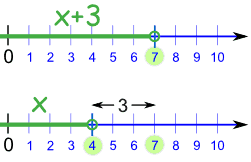
number line inequality x+3 < 7
x+3 < 7

x < 4
And that works well for adding and subtracting, because if we add (or subtract) the same amount from both sides, it does not affect the inequality
Example: Alex has more coins than Billy. If both Alex and Billy get three more coins each, Alex will still have more coins than Billy.

What If I Solve It, But "x" Is On The Right?

No matter, just swap sides, but reverse the sign so it still "points at" the correct value!
Example: 12 < x + 5
If we subtract 5 from both sides, we get:
12 - 5 < x + 5 - 5    
7 < x
That is a solution!
But it is normal to put "x" on the left hand side ...
... so let us flip sides (and the inequality sign!):
x > 7
Do you see how the inequality sign still "points at" the smaller value (7) ?
And that is our solution: x > 7
Note: "x" can be on the right, but people usually like to see it on the left hand side.

Multiplying or Dividing by a Value

Another thing we do is multiply or divide both sides by a value (just as in Algebra - Multiplying).
But we need to be a bit more careful (as you will see).


Positive Values

Everything is fine if we want to multiply or divide by a positive number:

Solve: 3y < 15

If we divide both sides by 3 we get:
3y/3 < 15/3
y < 5
And that is our solution: y < 5


Negative Values

warning!When we multiply or divide by a negative number
we must reverse the inequality.


Why?

Well, just look at the number line!
For example, from 3 to 7 is an increase,
but from -3 to -7 is a decrease.
number line -7<-3 and 3<7
-7 < -37 > 3
See how the inequality sign reverses (from < to >) ?
Let us try an example:

Solve: -2y < -8

Let us divide both sides by -2 ... and reverse the inequality!
-2y < -8
-2y/-2 > -8/-2
y > 4
And that is the correct solution: y > 4
(Note that I reversed the inequality on the same line I divided by the negative number.)
So, just remember:
When multiplying or dividing by a negative number, reverse the inequality

Multiplying or Dividing by Variables

Here is another (tricky!) example:

Solve: bx < 3b

It seems easy just to divide both sides by b, which gives us:
x < 3
... but wait ... if b is negative we need to reverse the inequality like this:
x > 3
But we don't know if b is positive or negative, so we can't answer this one!
To help you understand, imagine replacing b with 1 or -1 in the example of bx < 3b:
  • if b is 1, then the answer is x < 3
  • but if b is -1, then we are solving -x < -3, and the answer is x > 3
The answer could be x < 3 or x > 3 and we can't choose because we don't know b.
So:
Do not try dividing by a variable to solve an inequality (unless you know the variable is always positive, or always negative).

A Bigger Example

Solve: (x-3)/2 < -5

First, let us clear out the "/2" by multiplying both sides by 2.
Because we are multiplying by a positive number, the inequalities will not change.
(x-3)/2 ×2 < -5 ×2  
(x-3) < -10
Now add 3 to both sides:
x-3 + 3 < -10 + 3    
x < -7
And that is our solution: x < -7

Two Inequalities At Once!

How do we solve something with two inequalities at once?

Solve:

-2 < (6-2x)/3 < 4
First, let us clear out the "/3" by multiplying each part by 3:
Because we are multiplying by a positive number, the inequalities will not change.
-6 < 6-2x < 12
Now subtract 6 from each part:
-12 < -2x < 6
Now multiply each part by -(1/2).
Because we are multiplying by a negative number, the inequalities change direction.
> x > -3
And that is the solution!
But to be neat it is better to have the smaller number on the left, larger on the right. So let us swap them over (and make sure the inequalities point correctly):
-3 < x < 6

Summary

  • Many simple inequalities can be solved by adding, subtracting, multiplying or dividing both sides until you are left with the variable on its own.
  • But these things will change direction of the inequality:
    • Multiplying or dividing both sides by a negative number
    • Swapping left and right hand sides
  • Don't multiply or divide by a variable (unless you know it is always positive or always negative)
QUESTION

Q.1


Solve -4x > -12
A
x > 3
B
x > -3
C
x < 3
D
x < -3


Q.2


Solve the inequality 3(4 - y) ≥ 9
A
y ≤ 1
B
y ≥ 1
C
y ≤ -1
D
y ≥ -1


Q.3


Solve the inequality 3x - 7 < 5
A
x < -2/3
B
x > 4
C
x < 4
D
x < -4

Logorithm

LOGORITHM


In its simplest form, a logarithm answers the question:
How many of one number do we multiply to get another number?
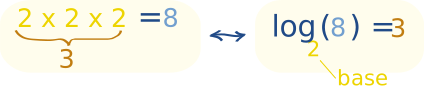
Example: How many 2s do we multiply to get 8?
Answer: 2 × 2 × 2 = 8, so we had to multiply 3 of the 2s to get 8
So the logarithm is 3

How to Write it

We write "the number of 2s we need to multiply to get 8 is 3" as:
log2(8) = 3

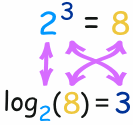
So these two things are the same:
logarithm concept 2x2x2=8 same as log_2(8)=3
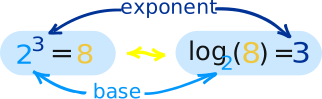
The number we are multiplying is called the "base", so we can say:
  • "the logarithm of 8 with base 2 is 3"
  • or "log base 2 of 8 is 3"
  • or "the base-2 log of 8 is 3"

Notice we are dealing with three numbers:

  • the base: the number we are multiplying (a "2" in the example above)
  • how many times to use it in a multiplication (3 times, which is the logarithm)
  • The number we want to get (an "8")

More Examples

Example: What is log5(625) ... ?

We are asking "how many 5s need to be multiplied together to get 625?"
5 × 5 × 5 × 5 = 625, so we need 4 of the 5s
Answer: log5(625) = 4

Example: What is log2(64) ... ?

We are asking "how many 2s need to be multiplied together to get 64?"
2 × 2 × 2 × 2 × 2 × 2 = 64, so we need 6 of the 2s
Answer: log2(64) = 6

Exponents

Exponents and Logarithms are related, let's find out how ...
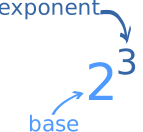
2 cubedThe exponent says how many times to use the number in a multiplication.
In this example: 23 = 2 × 2 × 2 = 8
(2 is used 3 times in a multiplication to get 8)
So a logarithm answers a question like this:
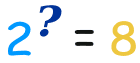
2 with what exponent = 8
In this way:
2^3=8 becomes log_2(8)=3
The logarithm tells us what the exponent is!
In that example the "base" is 2 and the "exponent" is 3:
2^3=8 becomes log_2(8)=3
So the logarithm answers the question:
What exponent do we need 
(for one number to become another number)
 ?
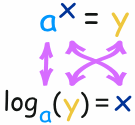
The general case is:
a^x=y becomes log_a(y)=x
Example: What is log10(100) ... ?
102 = 100
So an exponent of 2 is needed to make 10 into 100, and:
log10(100) = 2
Example: What is log3(81) ... ?
34 = 81
So an exponent of 4 is needed to make 3 into 81, and:
log3(81) = 4

Common Logarithms: Base 10

Sometimes a logarithm is written without a base, like this:
log(100)
This usually means that the base is really 10.
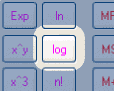
log
It is called a "common logarithm". Engineers love to use it.
On a calculator it is the "log" button.
It is how many times we need to use 10 in a multiplication, to get our desired number.
Example: log(1000) = log10(1000) = 3

Natural Logarithms: Base "e"

Another base that is often used is e (Euler's Number) which is about 2.71828.
calculator ln button
This is called a "natural logarithm". Mathematicians use this one a lot.
On a calculator it is the "ln" button.
It is how many times we need to use "e" in a multiplication, to get our desired number.
Example: ln(7.389) = loge(7.389) ≈ 2
Because 2.718282 ≈ 7.389

But Sometimes There Is Confusion ... !

Mathematicians use "log" (instead of "ln") to mean the natural logarithm. This can lead to confusion:
ExampleEngineer ThinksMathematician Thinks 
log(50)log10(50)loge(50)confusion
ln(50)loge(50)loge(50)no confusion
log10(50)log10(50)log10(50)no confusion
So, be careful when you read "log" that you know what base they mean!

Logarithms Can Have Decimals

All of our examples have used whole number logarithms (like 2 or 3), but logarithms can have decimal values like 2.5, or 6.081, etc.
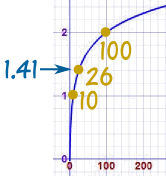
Example: what is log10(26) ... ?
logGet your calculator, type in 26 and press log
Answer is: 1.41497...
The logarithm is saying that 101.41497... = 26
(10 with an exponent of 1.41497... equals 26)

This is what it looks like on a graph:
See how nice and smooth the line is.
 log 10 of 26
Read Logarithms Can Have Decimals to find out more.

Negative Logarithms

Negative? But logarithms deal with multiplying.
What is the opposite of multiplying? Dividing!

A negative logarithm means how many times to divide by the number.
We can have just one divide:
Example: What is log8(0.125) ... ?
Well, 1 ÷ 8 = 0.125,
So log8(0.125) = −1
Or many divides:
Example: What is log5(0.008) ... ?
1 ÷ 5 ÷ 5 ÷ 5 = 5−3,
So log5(0.008) = −3

It All Makes Sense

Multiplying and Dividing are all part of the same simple pattern.
Let us look at some Base-10 logarithms as an example:
 NumberHow Many 10sBase-10 Logarithm
10 times larger / smaller.. etc..   
10001 × 10 × 10 × 10log10(1000)= 3
1001 × 10 × 10log10(100)= 2
101 × 10log10(10)= 1
11log10(1)= 0
0.11 ÷ 10log10(0.1)= −1
0.011 ÷ 10 ÷ 10log10(0.01)= −2
0.0011 ÷ 10 ÷ 10 ÷ 10log10(0.001)= −3
.. etc..   
Looking at that table, see how positive, zero or negative logarithms are really part of the same (fairly simple) pattern.


QUESTION


Q.1

Write 1,024 = 210 in logarithmic form

A
log2(1,024) = 10
B
log10(1,024) = 2
C
log2(10) = 1,024
D
log10(2) = 1,024


Q.2

What is log2(0.015625)?

A
-5
B
-6
C
-7
D
-8


Q.3

What is log3(729)?

A
4
B
5
C
6
D
7

Combinations and Permutations

Combinations and Permutations What's the Difference? In English we use the word "combination" loosely, without thinking i...